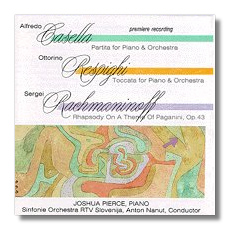
Casella, Respighi, Rachmaninoff
PHCD124 | Phoenix CD
| Name | Credit | |
|---|---|---|
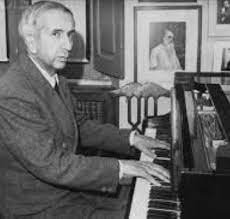 |
Alfredo Casella | Composer |
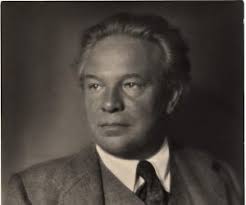 |
Ottorino Respighi | Composer |
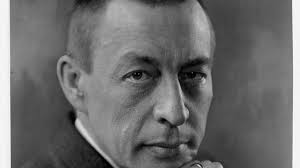 |
Sergei Rachmaninoff | Composer |
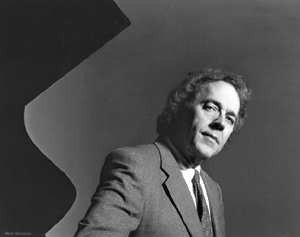 |
Joshua Pierce | Piano |
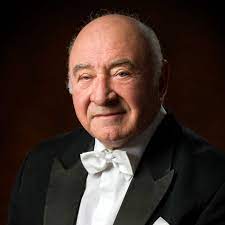 |
Anton Nanut | Conductor |
Partita for Piano and Orchestra
Toccata for Piano and Orchestra
Rhapsody on a Theme of Paganini
PHCD124 | Phoenix CD
| Name | Credit | |
|---|---|---|
|
Alfredo Casella | Composer |
|
Ottorino Respighi | Composer |
|
Sergei Rachmaninoff | Composer |
|
Joshua Pierce | Piano |
|
Anton Nanut | Conductor |
Ottorino Respighi Toccata for Piano and Orchestra
Sergei Rachmaninoff Rhapsody on a Theme of Paganini
Alfredo Casella Partita for Piano and Orchestra
Sinfonie Orchestra Radio Television Slovenija
Anton Nanut, conductor
Joshua Pierce, piano
This vivid collection brings together three major early‑20th‑century works for piano and orchestra, each revealing a different facet of the era’s color, virtuosity, and expressive breadth. Alfredo Casella’s Partita balances neoclassical clarity with bold orchestral writing, while Ottorino Respighi’s Toccata showcases his trademark brilliance and rhythmic drive in a rarely heard concertante score. Sergei Rachmaninoff’s Rhapsody on a Theme of Paganini, the most familiar of the three, remains a masterclass in variation form, lyricism, and pianistic sweep. Pianist Joshua Pierce, partnered with conductor Anton Nanut, delivers performances that highlight the stylistic individuality of each composer while unifying the program through precision, energy, and orchestral color.
At twenty-one minutes Respighi’s Toccata for Piano and Orchestra is really more of an extended concert piece, which opens in a chaconnelike frame of mind with some heavy, massive chords and solemn voicings, then segues into a lyrically musing Andante before the somewhat belligerent “toccata” proper takes charge. Although there once existed two rarely encountered LP recordings, this version supersedes both on all grounds, particularly because of the theatrically emphatic flair of its presentation.
Pierce and Nanut reinforce the neo-Baroque sympathies of this program with a first recording of Alfredo Casella’s “Partita for Piano and Orchestra.” Though Casella wrote numerous concertos, somehow he never got around to an actual piano concerto, and this “partita”-in which the soloist and his accompanists interface in a more collaborational than oppositional spirit-lives up to the historical and formal associations of the genre in the reach and rigor of its ideas and their elaboration. Not at all the expected neoclassical romp in brittle, tinkling “concertina” style, its three movements (Sinfonia-Passacaglia-Burlesca), with their spiky, driving, polytonal modalism and allusions to Italian folk tunes, show Casella’s forceful fluency in its strongest light: in fact, this may be among the best of the composer’s many essays in the concertante idiom.
A comparably dry, detached, and deliberative approach is applied most fruitfully to that old late- Romantic virtuoso warhorse-the Rachmaninov Paganini Rhapsody (hence the “Italian Connection”), thus illuminating a whole new facet of the Russian composer by transforming the “rhapsody” into an example of the kind of variational neoclassicism which Eric Salzman pinpoints so well in his excellent annotation, and therefore enabling the Rachmaninov to fit right into this program of works all written within the same ten-year span (1924-34). All three performance on this Phoenix release are extraordinarily well meshed: Pierce and Nanut work together like a team of well-trained thoroughbreds, and the Yugoslavian engineers supply a matchingly sharp, vibrant close-up acoustics. Highly recommended.
Paul A. Snook Fanfare Magazine