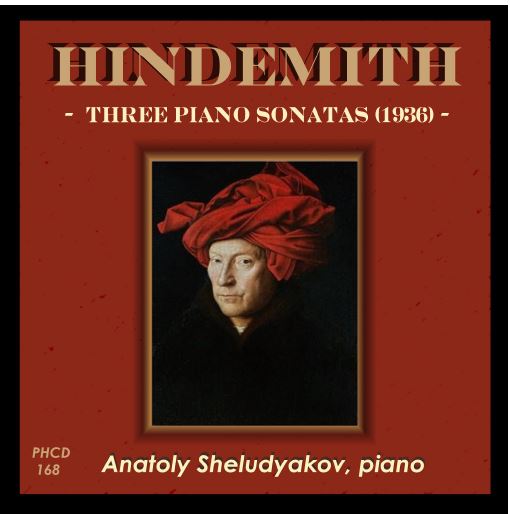
THREE PIANO SONATAS
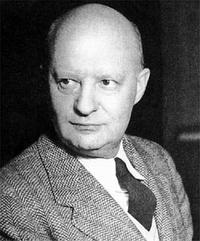
Paul Hindemith is one of the “four pillars” that support the grand edifice of contemporary music, the other three being Arnold Schoenberg, Igor Stravinsky, and Bela Bartok. Each of these sonatas is distinct in musical content, but took shape under some degree of influence from the others, which can justify labeling them a sonata-trilogy.
It was in the second half of Hindemith’s career—after the composition of the opera Mathis der Maler (1933–5) and the campaign against it by the Nazis, which eventually forced his emigration from Germany—that Hindemith produced his major utterances for solo piano. In his three piano sonatas, all written in 1936, Hindemith presents himself not as the rebel and revolutionary of the 1920s, but rather as an heir to the contrapuntal skill and keyboard dexterity of Johann Sebastian Bach.
The First Sonata is the most romantic in tone and the most comprehensive. In a prefatory authorial comment, Hindemith stated: ”Friedrich Hölderlin’s poem ‘Der Main’ was the stimulus behind the writing of this sonata.” However, the programmaticism here possesses only a general character and the music itself is linked to the poem only in its emotional tone, which ranges from an unclouded agitation to the joy of poetic wandering and reminiscences of a distant youth spent along the banks of a quiet river. The sonata consists of five movements, of which the first and fourth are lyrical and may be viewed as a prelude and interlude in relation to the other three. The second movement is a funeral march, the third a bright scherzo, full of energy and bluster. The fifth movement is the Finale, the one movement to be composed in sonata form, suffused with optimism, light and the radiant energy of creation.
Modest in scope, the Second Sonata could be labeled a sonatina, thanks to the unpretentiousness and relative lightness of the material. The cycle of movements is classically formed: a sonata allegro, scherzo, and rondo, the last movement being preceded by a sad and pensive adagio (comparable to the introductory sections of some of Haydn’s sonatas). The orientation toward the Early Classical Period is evident in the sonata’s general appearance and especially in the overtly Haydnesque theme of the rondo-finale.
The Third Sonata appears to combine traits of the previous two: the developmental quality and weight of the First with the laconism and brilliance of the Second. Here in a most concentrated aspect one finds Hindemith’s rich thematicism presented in full. The sonata begins with a song theme cast in the rhythm of a Siciliana inspired by Early Romantic lyricism, yet intensified by an archaic modality. The center section has the character of an instrumental toccata, in which the tiny motives reminiscent of Scarlatti and of etudes perform the role of further intensifying the preceding, thus adding drama to the lyrical element of the first section. The sonata’s second movement is a scherzo in the manner of Schumann: both dynamic and energetic.
Another type of theme appears in the third movement (a sonata form without a development). Here a march character is linked with a lyrical element, while the periodicity of the melodic couplets speaks to German Lied traditions. Archaic and austere musical material is used in the themes of the finale, which unfolds in the complex form of a double fugue, featuring separate expositions of the themes. With its firm and nearly fanatically obsessive ostinato, the first theme brings to mind the treatment of a fugue’s theme as something to be boldly proclaimed and unwaveringly professed. Meanwhile, the very idea of the fugal finale is akin to the idea of a passacaglia, which does not suggest the growth and change of themes in various tonal and harmonic combinations, so much as their hymnlike affirmation.